

Adhaar-enabled Payment System or AePS has been a game changer for India. It encourages financial inclusion in rural India and allows last mile users to become an active part of the formal economy. Introduced in 2010, AePS allows Aadhaar card owners to use their unique identification number to carry out cash transactions from micro ATMs or point-of-sale (PoS) counters. Especially in the rural areas, where traditional banking infrastructure is yet to make in-roads, AePS provides relief to the users.
Today, AePS has become a vital cash withdrawal method in rural India and the government also uses it to provide subsidies through Pradhan Mantri Jan Dhan Yojana (PMJDY). However, there are several challenges faced by AePS agents in rural India that are restricting a significant scale-up.
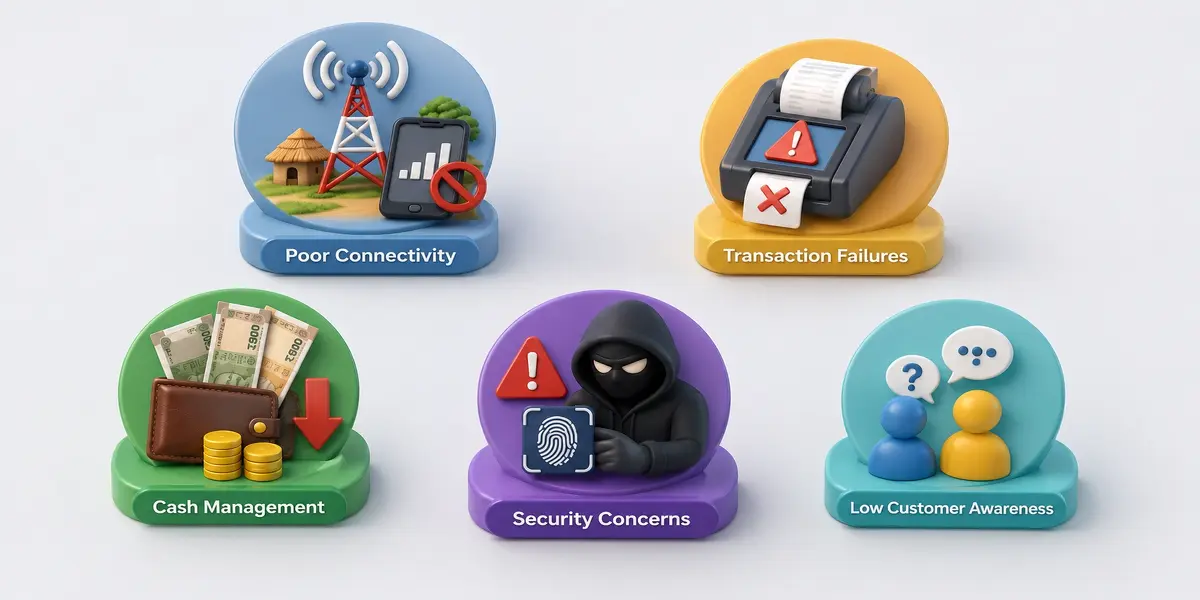
Top AePS agents challenges include underdeveloped infrastructure, Aadhaar-enabled payment system issues, frauds and security threats, AePS device support, authentication issues, limited agent or client financial literacy etc. AePS service providers in India serve as a major point of contact in rural India and facilitate rural banking solutions in India addressing their challenges.
Let us understand in detail what these challenges are and how a reliable e-governance brand association can help the agents resolve the issues.
Common AePS agents challenges faced by AePS agents in rural India
1. Biometric authentication failures
The Aadhaar-based system is heavily reliant on biometric authentication, such as fingerprint verification. It often fails for a large number of rural populations due to various challenges. This problem is particularly relevant among the old people and the labourers, who may have worn out or damaged fingertips. In such cases, failed AePS authentication can prevent customers from accessing their accounts to check balance or making cash transactions.
Additionally, authentication failures and Aadhaar-enabled payment system issues make the agents helpless and frustrated, as service instabilities cause risk of losing customers and subsequent income due to service instability. It can be problematic for certain segments of the population, particularly those who are illiterate, elderly, or physically challenged.
2. Network or connectivity issues
Rural AePS agents operate in areas that often have unreliable internet and limited power supply. These issues significantly challenge and disrupt AePS services and cause transaction failures and aggravates AePS agents challenges. Though National Payment Corporation of India (NPCI) has tried to provide AePS device support through offline transaction capabilities, inconsistent network coverage still remains a major hurdle for the agents. The unreliable infrastructure causes delays and service disruptions for the users and can bring down trust in AePS.
3. Fraud concerns
The rural AePS agents’ challenges worsen when they and their customers become vulnerable to the various security risks and frauds. Moreover, there have been cases where some unauthorised or untrained agents themselves have contributed to the problem by orchestrating fraudulent activities. They store biometric data or conduct unauthorised withdrawals by influencing and defrauding unaware and uninformed customers.
Frauds also take place through biometric spoofing, where fraudsters use cloned fingerprints that are made from leaked Aadhaar data to conduct fraudulent withdrawals. Fraudsters also exploit weak Know Your Customer checks and open fake or ghost Aadhaar-linked accounts, which they use to divert government provided subsidies or funds.
Though AePS depends on biometric authentication, it often does not provide real-time SMS alerts. When these notifications are either not delivered or are delayed, the users may not be able to find out about the fraud until it gets too late.
The unsafe handling and storage of Aadhaar card and bank account data can cause data leaks and Aadhaar identity theft, which can further cause various Aadhaar-enabled payment system issues, undermining trust in the system. Some of the ways to prevent AePS frauds in rural areas are buying only authorised devices from registered AePS service providers India, using two-factor authentication, real-time notifications, regular user and agent training.
4. Lack of Digital Literacy/ Lack of Availability
A large portion of the rural population is not aware about AePS services or is not digitally literate to be able to practice data safety measures. This makes the customers, especially the elderly, vulnerable to fraudulent activities. On the ground, it is often the AePS agents who keep educating and assisting the customers, which is an addition to their work pressure and at times slows down the flow of transactions.
Lack of financial literacy causes lack of trust in the digital AePS system, creating fear as a barrier to its adoption. Additionally, not all the villages have enough trained AePS agents. However, with Religare Digital, one of India’s leading AePS service providers India, thousands of trained agents are taking over to provide rural banking solutions in India.
5. Operational limitations
For the Aadhaar-based payment system to be implemented in the rural and remote areas of the country, it is important to have a strong technological infrastructure. However, this has been a longstanding issue in the system’s effective use and acceptance.
Often due to operation limitations and business viability issues, smooth AePS operations are interrupted. The agents regularly use AePS device support to resolve technical issues. AePS agents often need to manage sufficient cash flow to meet the withdrawal demands of customers, especially during the peak demand time.
Conclusion
In this article, we have seen the top five AePS agents challenges in rural India that may pose obstruction for financial inclusion in rural India. The challenges, such as frauds, lack of digital literacy, network connectivity must be addressed if Aadhaar Payment Systems need to scale up and emerge as a secure and trustworthy payment solution.
AePS can be strengthened with rural banking solutions India, such as real-time notifications, two-factor authentication, secure biometric authentication to resolve Aadhaar-enabled payment system issues.
By getting associated with authentic AePS service providers India such as Religare Digital, agents in rural India can adopt secure payment processing technologies through Aadhaar authentication and well-organised Know Your Customer protocols. With regular training and AePS device support, AePS agents can increase awareness and trust for digital payments in their area. With consistent efforts, technology interventions and timely solutions, AePS can continue to be an inclusive and reliable digital payment system for millions of Indians living in rural areas.